For most people, spending a week in South Korea would include countless hours lost at skincare mecca Olive Young, appointments at colour theory clinics and scalp analyses. My trip was a little different.
Across a jam-packed seven days, I travelled across four cities sampling everything the country’s startup ecosystem had to offer. I saw medical testing facilities with human-sized robots, electric ships hosting startup pitches and university campus coworking spaces heaving with entrepreneurship students.
South Korea is better known globally for its corporates than its startups: Samsung, Hyundai, SK and LG are all household names, and they built the country into a global force in semiconductors, cars, shipbuilding and electronics. But slowly, Seoul’s startup scene is growing. It’s becoming more recognised internationally as a serious hub, and the country wants that success to spill out of the capital.
This year, South Korea’s Ministry of SMEs and Startups named four cities — Daejeon, Gwangju, Ulsan and Daegu — its first Startup Cities, which it wants to be able to play on a global stage.
My trip coincided with 2026 Startup Korea Investment Week — a conference bringing together South Korean startups with national and international investors. I landed, very jetlagged, straight into its Global Conference in Daejeon, 140 km south of Seoul in the middle of the country.
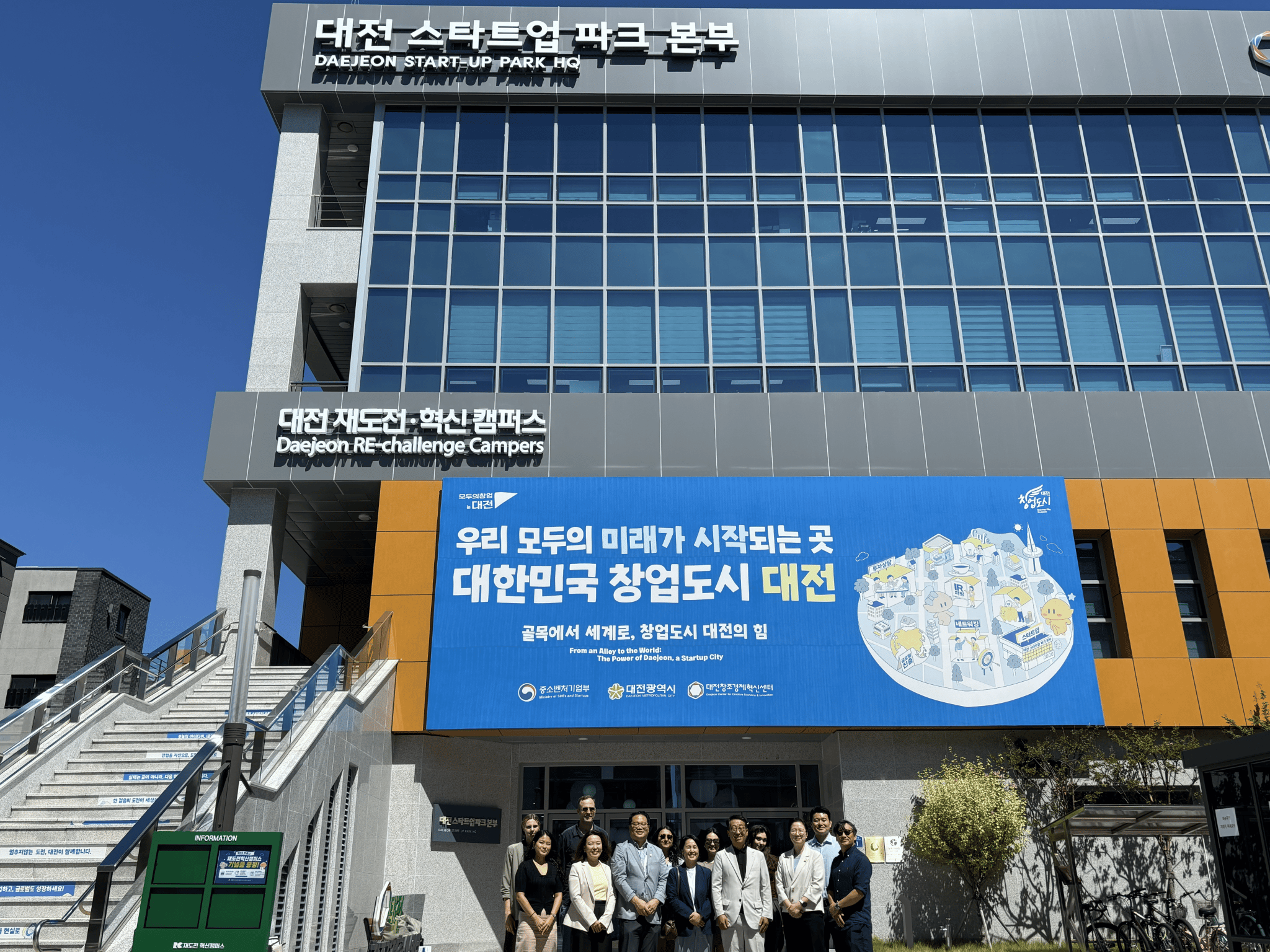
Daejeon — aside from being home to cult bakery Sungsimdang, which can now claim to have fed both Pope Francis and me — was the first city to open one of South Korea’s 17 centres for creative economy and innovation (CCEI) which aim to connect startups with the people and money they need.
These centres have both local and national government backing, and each one is paired with one of Korea’s corporate conglomerates to provide backing, mentorship and, potentially, a first customer: SK in Daejeon, Samsung in Daegu and Lotte in Busan, for example. The centres provide Korean startups — and international startups wanting to set up in the country — with specialised support like fundraising education, access to VCs, introductions to corporations and special tax benefits, including a 100% exemption for their first three years of operation and 50% for the next two, with bigger cuts the further they are from Seoul.
Daejeon, widely considered a tier 2 city, is the front runner. The city has invested in creating more attractive work zones built around 10 decentralised buildings and workplaces, their surrounding living spaces and third spaces like cafes. “Startup employees can just roll out of bed in their slippers and go to work. And then they can go right next door to drink, relax and socialise,” Hwang Yun-sung, head of innovation strategy at Daejeon CCEI, told me.
To attract international talent and companies, one of these work zones, Yuseong-gu, is more foreign-friendly: people speak English (officials claim there’s “virtually no language barrier”), there are international schools, different cuisines available and, I’m told, home setups are more Western when it comes to decor.
It feels like the city wants to emulate the culture in San Francisco, and it must be working — anecdotally, everyone I spoke to said that South Korea has a culture of long lead times for meetings but, in these working zones, you can get a chat set up in 30 minutes. I obviously tested it out, and managed to set up a coffee meeting with a founder on the day — yes, it might have helped that I’m media, but I’ll take it.
Korea’s ‘MIT’ is a deeptech powerhouse
A bunch of deeptech startups are launched every year in Daejeon, and 70% of all Korean patents are registered in the city. One reason for this might be the country’s answer to MIT: the Korea Advanced Institute of Science and Technology, better known as KAIST.
In 2022, KAIST changed the law that governs it to make supporting startups part of its official mission. It now produces more than 100 startups a year, with around 90 built by students and the rest by its faculty. Students can also take unlimited leave from studying to start a company: “It’s fine if you come back in 10 or even 20 years,” the team who run KAIST’s startup programme say. “If you’re good enough to get into KAIST, you don't need to worry about finding a job, so start a business first.”
Its reputation and alumni have caught the attention of VCs, but the university charges them for the privilege of seeing the companies. Top-tier local funds and international VCs pay KAIST 20m Korean won (€13.4k) a year, while accelerators pay 10m (€6.7k), and they’re vetted before being introduced to founders — the university is keen to protect young naive founders from time wasters, bad actors and predatory valuations. If VCs pass the test, which includes actually having capital to invest, they’re welcome to the campus coworking space, where each office’s glass windows are filled with post-its, strategy goals written with wipe off markers, and financial targets. Desks are crammed with Macbooks, teddies, Korean snacks and copious amounts of iced Americanos, South Korea’s unofficial national drink.
If you’re good enough to get into KAIST, you don't need to worry about finding a job, so start a business first.
Daejeon does still have its challenges, though. It struggles with the fact that 80% of the investment money in South Korea sits in Seoul, and founders still have better success accessing it if they’re based there. Part of the reason is market size: Daejeon has a population of 1.47m, with 700k working age, not enough to make it competitive. So companies grow up in Daejeon, make use of its benefits, and then leave for the shiny lights of Seoul.
Matching startups with corporate giants
A couple of hundred kilometers away — or an hour and a half away on Korea’s high-speed KTX train — is Ulsan, a city on South Korea’s south-east coast attempting a different model to Daejeon. Ulsan has 1.1m people and the highest GDP per capita in the country, at about 1.7x the national average. Why? Traditional industries like shipbuilding, cars, and petrochemicals are based here, as are corporates like Hyundai Motors, HD Hyundai Heavy Industries and SK. Ulsan’s CCEI strategy is to capitalise on that tradition.
Startups there are being plugged into giant incumbents in traditional industries. “Here, big industry can become a testbed, a customer and a market for startups,” said Jin-kyung Lee, head of global strategy at Ulsan CCEI. The centre runs Korea’s only open innovation programme focused on shipbuilding, with HD Hyundai, Samsung Heavy Industries, and Hanwha Ocean. Shipbuilding startups have raised more than ₩100bn (€67.1m) since the conception of CCEI.
Aside from operating like a standard open innovation programme — where corporates name their problems and the centre finds startups to solve them and supports the testing phase — Ulsan CCEI also publishes a wishlist of what corporates are looking to find in the next three to five years. Currently, the list mostly consists of robotics and AI solutions. The centre also invests directly at early-stage.
The benefit runs both ways, as corporates are desperate for help. A perfect example is HD Hyundai Heavy Industries, which has orders but not the workforce to fulfil them quickly enough. It’s using robots more, and is looking for startups to bring it the latest innovations faster and cheaper than it can build them.
Here, big industry can become a testbed, a customer, and a market for startups.
As someone who spends a lot of time talking and writing about software, getting to tour a shipping yard was a highlight of my trip. We were shown one of these collaborations in action: a four-legged spider-like robot, built by Diden Robotics, that climbs ship walls, welds, paints, grinds and more, replacing multiple skilled workers. Shipbuilders are also testing here, and we got to sail in a hybrid, soon-to-be fully autonomous, ship, as we watched shipbuilding-adjacent companies pitch to a boatful of CVCs and international funds. There are some unconventional mash-ups going on as well: I was gifted a toothbrush created by Proxy Healthcare that is meant to help remove tartar, but was told the technology could also be used to scrape barnacles off ships.
The corporate-startup relationship can be seen across big pharma too. Daegu, a city only about 70 km northwest of Ulsan, which has numerous hospitals and access to Korea’s large stores of electronic data, is betting on medtech, with drug companies partnering with early-stage startups there to get new products to market quickly.
Daegu is creating sandbox spaces and testing facilities that accommodate practicing clinicians testing on both animals and real patients — something I got to see on a visit to Daegu-Gyeongbuk Advanced Medical Industry Complex in the Innovation City, a state-backed medical campus created to develop new drugs.
The place is vast — it’s about the size of 150 full-size football pitches — made up of a new drug development centre, a medical device development Centre and a preclinical research centre.
Daegu is betting that clustering medtech companies in campuses like this will enable cheaper and quicker testing for startups. It also puts them in cross-functional facilities with doctors, AI engineers and founders, allowing for serendipitous conversations and collaborations. It also is betting on it being a one-stop shop for corporates and VCs to uncover top innovation quickly outside of Seoul.
Building out AI infrastructure
Gwangju is also clustering companies, but here — 270km southwest of the capital and under two hours away on the KTX — the focus is AI. The city believes that it can attract companies by investing heavily in AI infrastructure.
One initiative is the National AI Data Centre, which I visited on my trip. After taking our shoes off and getting hit by an odd smell that we were told is ‘just the tech’, we toured the space that’s trying to make local companies competitive by giving them access to compute power, storage space, and workspace. It also provides access to the latest Nvidia chips that can cost tens of thousands of dollars each, making it easier for early-stage companies to train and run AI models without needing to raise large rounds.
It’s run by the Artificial Intelligence Industry Cluster Agency (AICA) but backing comes from both central and city government. The agency is in charge of picking the companies and universities that get to use its benefits, either subsidised or for free. It says that companies it has supported have raised ₩56.3bn (€38m). It also runs its own AI fund to invest in local companies.
Thinking outside the local market
Travelling around South Korea’s startup cities, there’s a sense that the country is relying on these hubs to secure its tech future. It’s doubling down on the deeptech boom that has gripped major tech hubs like the US, China and Europe. KAIST is evidence that it’s betting on academics to give it a fighting chance of playing on a global stage; and the ecosystem knows its home market is too small to rely on it to win. “Our startups absolutely must go global,” one KAIST official told me. South Korea is also leaning on its corporate legacy to open doors — and is relying on their money too.
Global relevance comes from relationships. It comes from giving people a reason to come back.
But, for each of those cities, the challenges facing smaller ecosystems that want to play on the global stage are similar to the ones I’ve seen covering European tech: momentum and international capital.
What I heard from Korean founders is that when they meet VCs or potential customers abroad — or receive visitors like my tour — everyone says they’re great and can see potential. But “once they leave, everything gets cut off again,” one founder told me.
Eunseo Yi, CEO of 123 Factory, an accelerator bridging Korea and Europe, who organised the tour, agreed: “Global relevance comes from relationships, not from one event, not from one delegation, and not from one investment. It comes from giving people a reason to come back.”