
The UK has long been the runaway leader when it comes to tech funding in Europe. The country’s startup scene also holds its own on the global scene, boasting the third most valuable technology ecosystem in the world, according to Dealroom’s UK Tech: A Forward Look To 2025 report.
So far this year UK startups have raised €13.9bn in equity funding across 1,338 deals, according to Sifted data. That’s compared to second-placed Germany, which has seen €7.4bn raised across 547 deals, and third-placed France, with €7.3bn raised across 502 deals.
Business chiefs also hold the UK in higher stead than its peers on the continent when it comes to entrepreneurship. A 2025 survey by the Barclays Business Prosperity Index reveals that 62% of global tech business leaders consider the UK a more attractive location to grow and scale a tech business than mainland Europe.
There’s also a buzz flying about the British ecosystem at the moment. In the latest edition of Sifted Talks, we asked four experts what’s driving a surge in confidence in UK tech.
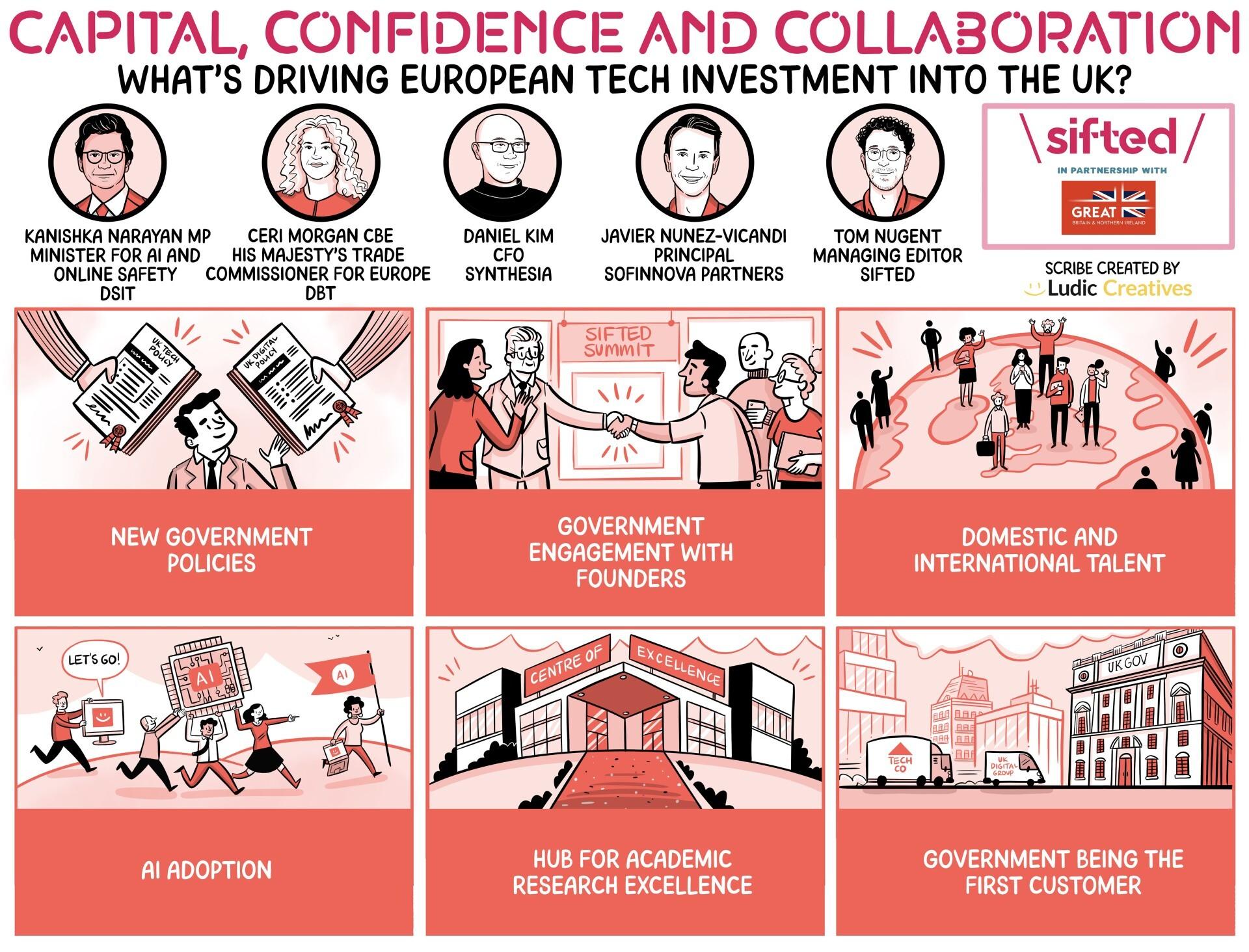
Our panel of experts included:
- Ceri Morgan CBE, His Majesty's Trade Commissioner for Europe, Department of Business and Trade
- Kanishka Narayan MP, Minister for AI and Online Safety, Department for Science, Innovation and Technology (DSIT)
- Javier Nunez-Vicandi, principal at European venture capital firm Sofinnova Partners, which invests in life sciences startups
- Daniel Kim, chief financial officer at AI-powered video platform Synthesia
Here are the key takeaways:
New government policies
From the government’s Modern Industrial Strategy and AI Opportunities Action Plan to new changes announced in last month’s Autumn Budget, UK tech has a lot to shout about.
One of the announcements from the recent Budget that aims to incentivise talent were changes to the country’s Enterprise Management Incentives (EMI) framework, designed to help startups attract talent by awarding employee shares in a company with minimal tax obligations. The employee limit and company share option limit have also been doubled, to 500 employees and £6m respectively.
“We are doubling the eligibility for enterprise tax incentives so scaleups can attract the capital and talent they need,” Morgan says. We are providing a new three year stamp duty exemption for firms that list in the UK. We are also maintaining the lowest rate of corporation tax in the G7.”
The government has also recently appointed Balderton's James Wise to lead its sovereign AI unit — tasked with helping to build and scale AI capabilities in the UK — and has named leaders from Google DeepMind and Monzo as “AI ambassadors” to help steer the country’s AI strategy.
The government’s new AI growth zones also promises £10bn of investment to build data centres between Newport and Bridgend.
“We've announced three AI growth zones in just the last three months, with billions in investment in each of those areas, firing up the fundamental input into modern AI. I was delighted that the last two were in North and South Wales.” - Kanishka Narayan MP, Minister for AI and Online Safety, Department for Science, Innovation and Technology
Domestic and international talent
Narayan explains that the UK is in a distinctive position when it comes to attracting international talent after the government announced its Global Talent Fund in July. The fund will award 12 selected UK research organisations with an institutional grant which will enable them to recruit international researchers in science and technology. The fund currently has £54m in backing from DSIT.
“If you're a young person who's building a product or focused on a startup, the UK is now one of the best places in terms of high potential and global talent visas, in light of recent changes that the Home Office has announced. There could be no more compelling story, both for domestic talent and for international talent.”
Narayan explains that as a result of the UK government being open and looking ahead, it is hoping that the very best talent from across the globe will come to build “great businesses” here.
For Kim, the growth of the talent pool in the UK has given companies what they need to stay in the country. “When you think about scaling compared to where we were five or ten years ago, we’ve come a long way. You can do the whole journey today. You can go from seed to growth rounds to global partnerships,” he says.
In UK cities such as London, there are far more loyal employees compared to Silicon Valley due to fewer options to jump ship, he adds.
“London is a bit more subdued, but it's great for a startup or scaleup, because you need that continuity during the hardest part of a company's journey.” - Daniel Kim, Synthesia
Hub for academic research excellence
The UK boasts a rich history of research and academic excellence, with three British universities — the University of Oxford, the University of Cambridge and Imperial College London — included in the Times Higher Education Top 10 World University Rankings 2026.
For Nunez-Vicandi, the UK’s strong academic history provides excellent opportunities for European investment. “The UK is the fourth best in research impact in life sciences. From that perspective, that early innovation and academic excellence can then drive subsequent growth and early-stage companies.”
The Oxford-Cambridge Growth Corridor initiative, which aims to create a science and technology innovation hub linking the universities of Oxford and Cambridge with neighbouring towns, is also contributing to overseas investment in the UK, adds Morgan.
She says: "I was in the Ox-Cam corridor a couple of weeks ago and I was looking at a Japanese startup that came to work in the UK, to be in the ecosystem. But there's all kinds of things going on.
“I think sometimes people are still seeing a kind of dusty spire attitude to the corridor. The learning is still there and really advancing and developing. I think that connectivity and the hive mind that's created around the corridor is pushing a lot of innovation.” - Ceri Morgan, His Majesty's Trade Commissioner for Europe, Department of Business and Trade
Government being the first customer
There are signs the government is leaning more into buying from early-stage startups.
During a wave of announcements in November, it committed to act as a "first-customer" for UK startups developing AI hardware products but who are struggling to get off the ground without investment. The initiative is backed by £100m in investment, something VCs expect to move the needle for the early-stage ecosystem.
“The government's role as a customer can be a huge driver of progress,” Narayan says.
“The key now is to take that change and make it more systemic so that every government department is able to get a good customer, send a clear demand signal for what they want to buy and then follow through in an accelerated, innovative way when it comes to sales cycles as well.”
From a healthcare perspective, the government acting as a customer is a welcome shift in investing, says Nunez-Vicandi. “We must ensure that the government is purchasers of these technologies, not only backers, particularly in the healthcare context where so much of the overall spend is institutionalised in systems such as the NHS.
“The more we can do to make the NHS as a healthcare system a better purchaser of technology, the more that it can stimulate the revenue growth in these companies.” - Javier Nunez-Vicandi, Sofinnova Partners