

Finding product-market fit (PMF) is a defining milestone for any startup — but what comes next determines whether momentum can turn into scale and growth.
As companies enter this next phase, founders must navigate decisions around product development, customer feedback, pricing and investment.
The smartest founders are already thinking ahead and planning their next moves in order to scale efficiently, unlocking new revenue streams and building resilient businesses.
But when should founders make these decisions and what do they need to think about as they grow?
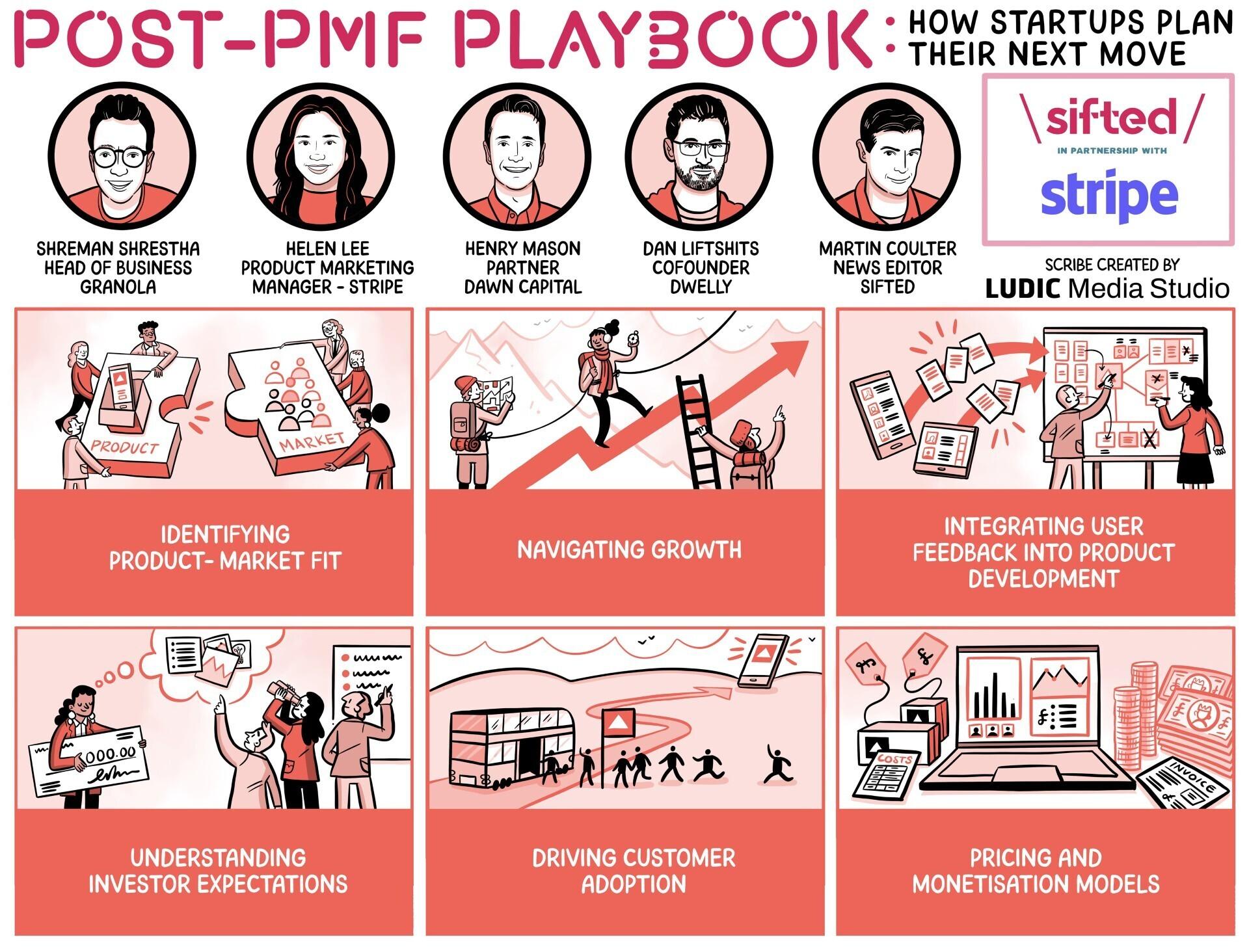
These questions were front-and-centre in our latest Sifted Talks, where we asked our panellists what to do after finding PMF, how pricing and revenue models support expansion and what signals investors look for when backing companies ready to scale.
Our panels of experts included:
- Helen Lee, product marketing manager at the programmable financial services company Stripe
- Henry Mason, partner at VC firm Dawn Capital
- Shreman Shrestha, head of business at AI meeting transcription Granola
- Dan Lifshits, cofounder of property technology firm Dwelly
Here are the key takeaways:
Identifying product-market fit
Identifying when your company has achieved product-market fit is the first and most important step. One key signal that a product is doing well is “seeing product adoption really grow” across the market, according to Shrestha.
It’s also an important sign when sales teams are aware that a product is doing well or is gaining traction. “Internal users are actually egging on the procurement team to get a tool or product finished as soon as possible,” he says.
When questioning whether a product is ready for the market, founders should also determine whether their product works economically, says Mason.
“Is the value that you're providing customers something they're willing to pay for? If I had a business where I give everyone a dollar every day, users would love it, but it's not going to work for me as a business,” he says. “That is where some founders haven't stress-tested the economics of their model.”
A lot of product market fit comes down to listening to what customers want, says Lee. “What our clients are doing is using Stripe to collect data and surface insights on how their end users are using their products,” she says.
What we found is that data becomes very powerful in telling our clients what their customers care about and where they're getting value from.” - Lee
Integrating user feedback into product development
Understanding and utilising customer feedback is a crucial step in growing a company, says Lifshits.
One of the core principles of any company should be “customer obsession”, something Lifshits says is at the forefront of Dwelly’s business strategy.
“Imagine in every product conversation that a customer is sitting around the table,” he says. “How would they react to all the conversations we're having about a product? Try to bring the customer perspective into every part of the business.”
One key strategy Granola is using to integrate user feedback is hosting interviews with users, adds Shrestha. “Anyone can join them and they play a very foundational role in how we think about the product development cycle.”
Before Granola was even publicly released, the founders would be running around London in person going to different VC firms to have potential customers and investors test pre-released versions of Granola” - Shrestha
Driving customer adoption
AI can be a useful way of driving customer adoption and business leaders at Dwelly are using the technology to understand customer sentiment, Lifshits says.
“We record some of the conversations with customers and then transcribe them with AI to understand the negative, neutral or positive sentiment of our customer base. You can have real-time product feedback this way.”
Investors at Dawn Capital can gain a real insight into whether a product is being adopted by customers through their customer calls, Mason says.
“When we're doing customer calls to assess whether we want to invest in a company,” he says. “One of the classic boilerplate questions is ‘would you recommend this to anyone?’ But I much prefer the question ‘have you recommended it to anyone?’ People then think, ‘oh yes, I actually have’.
Similarly, taking it away and asking how would feel if the product didn't exist tomorrow is a question we'd love to be able to theoretically test.” - Mason
Pricing and monetisation models
Over the last few years, there has been a gradual move towards flexible hybrid pricing models, often incorporating a flat rate and a dynamic fee tied to usage. This shift can often be put down to the rapid rise in AI. The technology has altered software pricing and compute costs because, unlike software that runs locally, AI requires massive, real-time computational power for every interaction
“Flexible pricing has become more common amongst the users we talk to,” says Lee. “The commonality tying all of this together is how fast everything is moving. Companies are launching new features all the time and you can't have monetisation be a bottleneck.”
For Dwelly, the most strategic monetisation strategy has been a “box” model, Lifshits says, where certain functions of the business are outsourced without having to build internal infrastructure.
“In a way it’s reverse franchising. Rather than run the operational activity in-house, we outsource it to those who would run the full end-to-end workflow.
That is effectively how we're trying to stretch the boundaries of value extraction to the maximum.” - Lifshits
84% of business leaders say that adapting pricing quickly will be a key competitive advantage in the next 1-2 years. Click here to see the pricing trends amongst the fastest-growing companies in Stripe's report.