Europe is about to get what is billed as its most powerful quantum computer. Later this year, Denmark expects to bring Magne online, built by Microsoft and Atom Computing and backed by €80m from the Novo Nordisk Foundation and EIFO.
It is a milestone, and it should be welcomed. But the harder question is not whether Europe can build one impressive machine, it’s what happens as quantum computing becomes commercially useful and we need not one, but many.
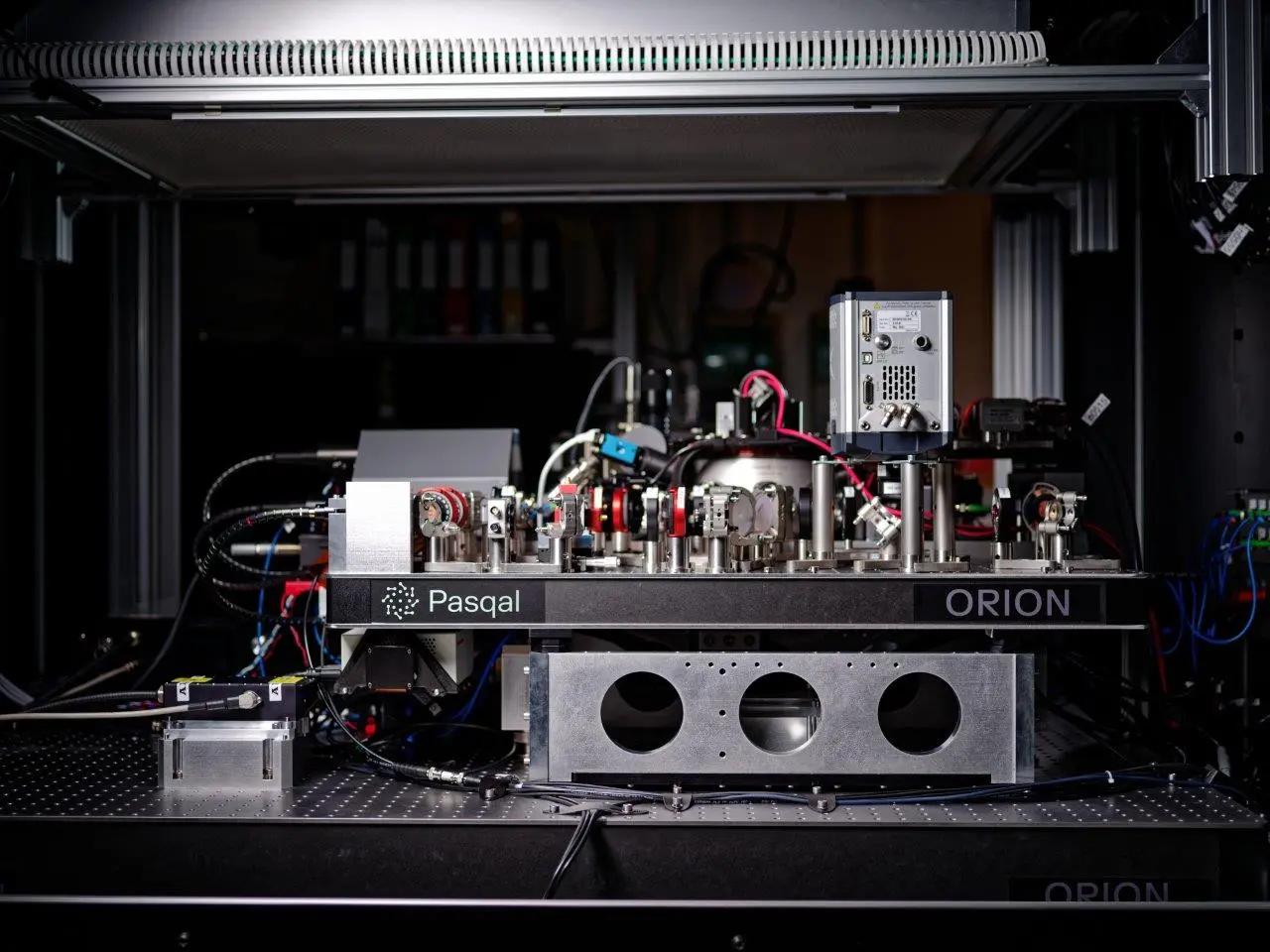
Atom Computing’s platform is based on neutral atoms, and that matters because the next phase of this industry will be decided by energy, space and deployability. While neutral atoms avoid the large-scale dilution refrigeration that superconducting systems require, which is certainly an architectural advantage, they still depend on a substantial stack of vacuum hardware, lasers, optical tweezers, detectors and control electronics. So even when the qubits themselves are elegant, their footprint remains a substantial piece of infrastructure, limiting their scalability.
As quantum computing becomes commercially useful, industry will want quantum computing capacity wherever it can solve real problems: in drug discovery, advanced materials, batteries, logistics, power grids, aerospace and manufacturing. We talk a lot about millions of qubits being the threshold to utility. We should also be thinking now about what happens when the market wants millions of quantum computers.
Size, weight, power and unit economics will matter as much in quantum computing as they do in AI. BloombergNEF, a research provider, forecasts US data centre power demand reaching 106 gigawatts by 2035, a 36% upward revision from an outlook published just seven months earlier.
Most people assume quantum computing is decades away from compounding this problem. It is not. And if it arrives on the trajectory the most heavily funded approaches are currently on, the energy demands from AI will look manageable by comparison.
Consider what building a useful quantum computer at scale requires under most approaches currently attracting the largest cheques.
An independent economic analysis published by ICM compared the power demands of different approaches at equivalent computational scale, specifically the 4,000 logical qubits considered the threshold for commercially useful problems.
For superconducting, photonic and ion-trap systems, the estimated power requirements are around 160, 100 and 140 megawatts respectively. For context, a modern hyperscale AI data centre runs at 100-200 megawatts. These are not modest additions to grid demand. They are whole facilities, built to serve a single machine.
The physical scale compounds the problem. Even photonic systems could require thousands of square metres, as projects already in development show. PsiQuantum, a photonic quantum computing company backed by $940m in joint Australian government funding, is building a warehouse-scale facility near Brisbane Airport to house thousands of quantum computing modules. The facility is 540k sq. ft and includes a main office building, a large-scale cryoplant and a quantum computing centre.
I raise this not to criticise PsiQuantum's science or ambition, I raise it because this is what quantum computing at scale looks like under these approaches, and it is reliant on the same grids already under strain from AI, on a faster timeline than most public commentary suggests.
At Quantum Motion we use silicon spin qubits, manufactured on the same 300mm CMOS wafer lines that produce laptop and smartphone chips. Our target utility-scale system will fit within five standard server racks, with a power draw below 200kW, around a thousand times less than other modalities at equivalent computational scale.
The silicon approach is earlier in its capital journey. We are not yet claiming to have solved every engineering challenge. We still need to prove that large silicon arrays can be made to behave uniformly, that cryogenic control and readout can be integrated without adding too much heat or crosstalk, that device variability can be driven down far enough for manufacturing to look repeatable and that strong physical qubit performance can be translated into logical qubits with reasonable overheads.
The good news is that recent results, from millikelvin cryo-CMOS control to 1,024-device integration below 1K and foundry-made spin-qubit unit cells above 99% fidelity, suggest those are engineering problems rather than fundamental ones. The pathway to a quantum computer that can sit in a data centre, draw power from an existing supply and serve many customers concurrently is, in our view, only achievable through this route.
The AI energy reckoning took most policymakers by surprise. The quantum one doesn’t have to. The question of how much power a useful quantum computer will consume, and where it will go, deserves the same scrutiny now being applied to AI infrastructure. The answers vary enormously depending on who you ask, and not all of them are compatible with a grid that is already near its limits.
Europe is rightly proud of what is being built in Denmark. The question worth asking is what comes after it, and whether we are planning for that honestly.