What the AI era means for hiring leadership
At Sifted Summit, founders, investors and operators came together to discuss what's changing in executive hiring. One point came through clearly: the executive talent market is moving faster than most hiring strategies.
Data from Thrive, a talent CRM used by search and investment firms, shows just how concentrated the market has become. Across more than 9,000 executive searches, 100 individuals appeared in more than one in five searches. That group saw 37× more demand than the average candidate.
The implication is bigger than talent scarcity. The executive market is increasingly divided between leaders with deep AI fluency and those with established operating experience, while relatively few combine both — for now, as the market catches up.
The talent market is dividing and the overlap is small
Growth-stage businesses still need executives who have scaled teams, managed complexity, raised capital and earned board confidence. At the same time, AI is creating demand for leaders who understand how the technology changes products, operating models and decision-making.

Those capabilities rarely sit in the same profile today. AI-forward leaders have often had less exposure to international scale, multiple functions or capital raising. Conversely, experienced operators may have the leadership track record a business needs but are still developing their AI fluency. The people who combine both profiles increasingly have another option: starting a company themselves.
This changes the hiring question. Which capabilities are genuinely non-negotiable for a business and where are we willing to trade?
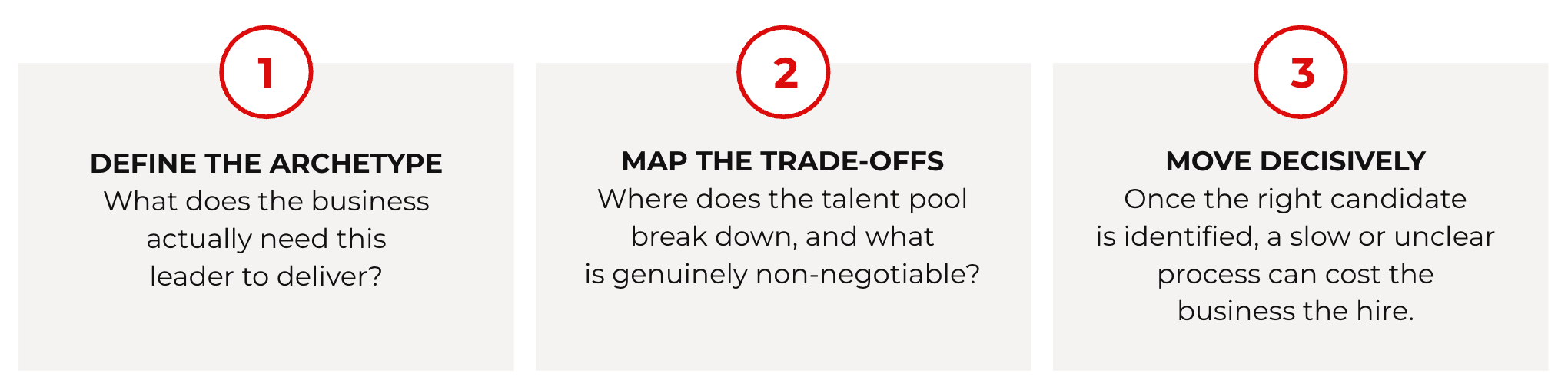
Start with the business problem, not AI
Adding “AI experience” to an executive specification can feel like the obvious response to the market. But it's often the wrong starting point.
The better question is: What does this leader actually need to accomplish over the next 12, 18 and 24 months?
Once that's clear, the role of AI fluency becomes easier to calibrate. For some businesses, deep AI capability will be essential. For others, a proven operator with strong judgment and learning agility may be better equipped to lead through the transition.

Getting all four specifications in one person is unlikely. The mistake is treating every desirable attribute as a must-have and then wondering why the market can't produce the candidate.
When AI capability does matter, the strongest candidates may also sit outside the obvious talent pools. Executives leading AI initiatives inside established companies can combine domain knowledge, operating experience and practical AI fluency without coming from a frontier AI company.
The Hiring Process is Part of the Investment Thesis
Getting the leadership profile right is only half the equation. The process itself can determine whether the business gets the candidate. Senior candidates are assessing the company as closely as the company is assessing them. Slow feedback, unclear timelines and disorganised interview stages can signal uncertainty, particularly when the strongest candidates have other options.
The businesses that hire well establish clarity early:
- Define the actual work, not just the title
- Agree on the outcomes that will define success
- Separate must-haves from trade-offs before meeting candidates
- Keep the process moving once the right candidate is identified
- Engage the top candidates with personal communications during the process
The consequences extend beyond an individual hire.

For investors, executive hiring is more than a functional HR issue. Leadership capability is part of the value-creation equation and the quality of the hiring process can either accelerate or constrain it.
What this means for investors
The executive talent market is unlikely to produce many candidates who tick every box. The better approach is to: